
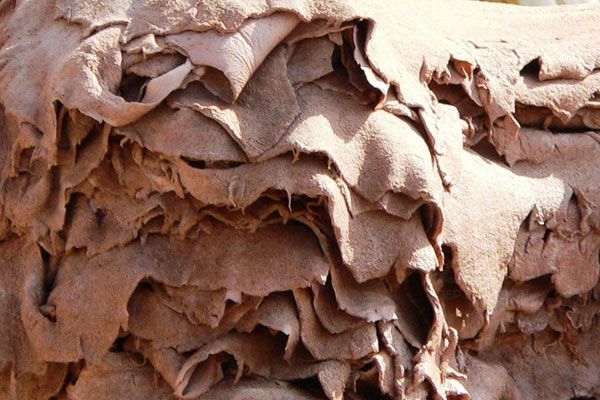
Animal bones, cattle hides, and slaughterhouse by-products can be difficult to process with conventional size-reduction equipment. Tough skins may wrap around rotating components, while bones require sufficient shearing force to achieve consistent size reduction. For slaughterhouses, rendering facilities, and animal by-product processors, these challenges can increase maintenance requirements, interrupt production, and complicate downstream treatment.
An Industrial-Grade Dual-Shaft Shredder for Animal Bones and Hides provides a practical solution for reducing the size of tough animal-derived materials before further processing, transportation, or disposal.
Why Choose a Dual-Shaft Shredder for Animal Waste?
Animal waste is not a uniform material. Depending on the source, it may contain bones, skin, muscle tissue, hooves, and other organic residues. Equipment selection must account for material toughness, moisture content, processing volume, and the required discharge size.
A dual-shaft shredder uses two counter-rotating shafts fitted with cutting tools to shear and tear incoming materials. Compared with equipment that relies primarily on high-speed impact, this operating principle is suitable for handling many tough and fibrous waste streams.
For facilities seeking a reliable Slaughterhouse Waste Shredder, important considerations include:
- Resistance to wrapping: Tough hides and fibrous tissues can interfere with feeding and continuous operation. Cutter geometry and anti-winding design should be selected according to the feedstock.
- Durability under demanding conditions: Animal bones can impose significant loads on cutting components. High-strength, wear-resistant cutters help manage demanding processing conditions.
- Consistent size reduction: The required output size depends on the next treatment stage, such as rendering, sterilization, incineration, or other approved disposal processes.
- Maintenance and operating costs: Accessible cutting components, appropriate sealing, and overload protection can help reduce avoidable downtime.
Heavy-Duty Animal Carcass Shredder for Downstream Treatment
A Heavy-Duty Animal Carcass Shredder is generally selected to prepare carcasses and related by-products for subsequent treatment. Pre-shredding reduces material volume and can improve feeding and handling efficiency in downstream systems.
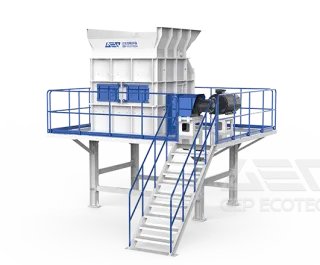
GEP ECOTECH's published animal-waste processing approach uses a chain-plate conveyor to feed material into a dual-shaft shredder, followed by a belt conveyor for discharge. The configuration can be adapted to suit the material and final size requirements.
For carcasses containing both soft tissue and hard bones, the machine should be evaluated against actual feedstock samples. Shredding alone does not constitute complete disinfection or guarantee compliance with animal by-product regulations. Where required, validated sterilization, rendering, or other approved treatment must follow.
Proven Applications: GEP ECOTECH Project References
GEP ECOTECH has published project information demonstrating the application of dual-shaft shredders to cattle hides and animal carcasses.
Case 1: Cattle Hide Processing in Australia
In June 2019, GEP ECOTECH commissioned shredding equipment for an Australian company producing gelatin from cattle hides. According to the company's published case study, the processing requirement was approximately 3 tonnes per hour, with a target output size of around 50 mm.
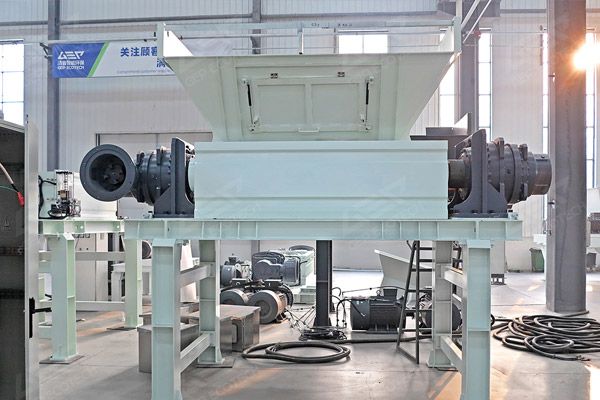
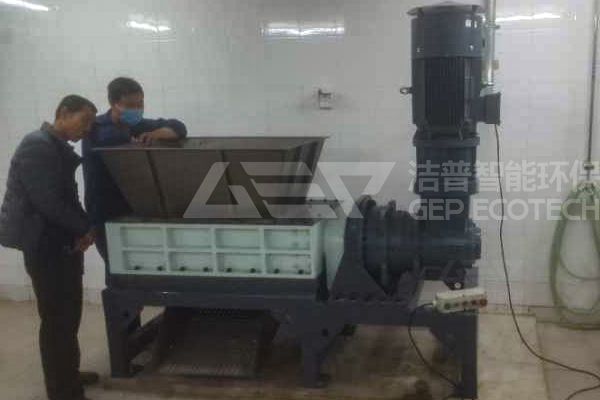
GEP ECOTECH recommended two GD6 dual-shaft shredders for the application. The GD series uses a shearing-and-tearing principle, with low-speed operation, high torque, and high shearing force to handle tough materials.
Case 2: Harmless Animal Carcass Treatment in Gansu, China
GEP ECOTECH also reports an animal carcass treatment project in Gansu, China. The published project information specifies a processing capacity of 1–3 tonnes per hour and a shredded material size of 50–100 mm. The processed carcasses and internal organs enter a subsequent treatment and resource-recovery process.
These figures describe a separate project and should not be interpreted as guaranteed performance for every material or installation.
How to Select the Right Industrial Shredder
Before choosing an industrial-grade dual-shaft shredder, buyers should establish the material composition, hourly throughput, required output size, operating schedule, and downstream treatment method. Bone dimensions, hide thickness, moisture content, and feeding conditions can all influence equipment configuration.
GEP ECOTECH provides dual-shaft shredding equipment for animal waste and related industrial applications. Rather than selecting a machine based on nominal capacity alone, buyers should confirm the configuration through material testing and engineering assessment.
Looking for a Slaughterhouse Waste Shredder or Heavy-Duty Animal Carcass Shredder? Contact GEP ECOTECH with your material type, target capacity, and required discharge size to discuss a suitable shredding solution.